Day Eye Cream vs Night Eye Cream: Two Briefs, Not One
The day product and the night product are two briefs, not one. They differ in texture, in packaging and in what the buyer expects from each jar. The client's page on the split notes that ODM work runs 4–8 weeks on an existing formula while OEM runs 3–6 months, and that stability and compatibility reports take 3–6 months. Plan both lanes before a single sample is approved.
Key takeaways
- Treat the morning and evening products as separate briefs; the page names reusing one formula for both as the common mistake.
- Texture, packaging and regional expectation each move between the two products.
- Reusing a library formula keeps the route to four or eight weeks, while a new development runs three to six months and carries its own test work.
- Stability and compatibility reports take 3–6 months, and a sensitive-skin claim also waits on patch test results.
Two briefs inside one category
Many brands open a single eye cream project and try to satisfy morning and evening with one fill. The client's own comparison page frames the pair as different needs. The morning product faces a fast routine, make-up wear and a user who wants quick absorption. The evening product faces longer contact time and a user who reads the label for renewal language. When those two expectations share one formula, one side always loses.
| Decision | Day brief | Night brief |
|---|---|---|
| Texture | Light, fast-set, layers under sunscreen | Richer, longer contact time on skin |
| Ingredient emphasis | Caffeine or niacinamide for a fresher look | Retinol or peptides for overnight language |
| Packaging cue | Pump or slim tube for speed | Heavier jar for a night ritual |
| Market expectation | Unfragranced and quick-absorbing | A visible renewal story |
The cost of the shortcut is not visible on a spec sheet. It shows up in reviews and in returns, because the buyer compares the two jars side by side on the same shelf. Building them as two briefs keeps texture, claim and packaging decisions honest from the first sample request.
Texture and finish split first
The day brief usually asks for a light, fast-set texture that sits under sunscreen without pilling. The night brief usually asks for something richer that stays on the skin for hours. These are two different targets for the same lab, and they are easier to hit when the brief names them separately instead of averaging them into one.
A brand that treats the day product as the only job will usually reuse the same base for the night eye cream and then simply thicken it. That shortcut is the mistake the client's page names. Thickening changes absorption, and absorption is the first thing an evening user notices.
Ingredient direction without cloning a formula
The ingredient palette stays broad on purpose: retinol, peptides, hyaluronic acid, vitamin C, caffeine, niacinamide and botanical extracts all appear on the client's eye cream pages. A brief does not need many of them at once. It needs a short list that matches the claim the brand is willing to defend on the front of the jar.
Where the two products separate is emphasis. A morning formula often leans on caffeine or niacinamide, while an evening formula often leans on retinol or peptides. Read the wider ingredient guidance in the eye cream development notes before you fix the actives, because pairing and stability rules decide how many can travel together.
Packaging carries half the message
The tube, jar or bottle is not a container decision made after the formula. On a two-product range it is the fastest way for a shopper to tell morning from night without reading a word. A pump for the day product and a heavier jar for the evening product do more work than a colour change alone.
The client's comparison page lists overlooking packaging and user experience as a common mistake. Packaging lead time is also named on the site as one of the schedule influences, so it belongs in the first planning call rather than the last. A pack that arrives late can hold a finished formula in the warehouse for weeks.
Regional expectation rewrites the same brief
The same two briefs read differently by market. Some regions reward a visible renewal story at night, while others reward a light, unfragranced texture in the morning. The page calls ignoring regional market preferences one of the mistakes, and it is an easy one to make when a single sample set is sent everywhere.
A practical fix is to fix the claim first and the texture second, market by market, then let the lab hold one base underneath. The base stays stable while the story and the finish move. That keeps the number of formulas small without pretending every market wants the same jar.
Where testing sits in the published project windows
Use the four published bars to build a calendar. An ODM project runs 4–8 weeks on an existing formula, and stability and compatibility reports take about 13–26 weeks. Book the fast ODM slot at 4 weeks and the earliest report at week 13: the wait after production samples finish is 13 - 4 = 9 weeks. Book the slow ODM slot at 8 weeks and the same wait becomes 13 - 8 = 5 weeks. If the brand plans to the outer edge, 26 - 4 = 22 weeks of buffer covers the slowest published testing window, and the midpoint (13 + 26) ÷ 2 = 19.5 weeks is a fair single figure for a launch chart.
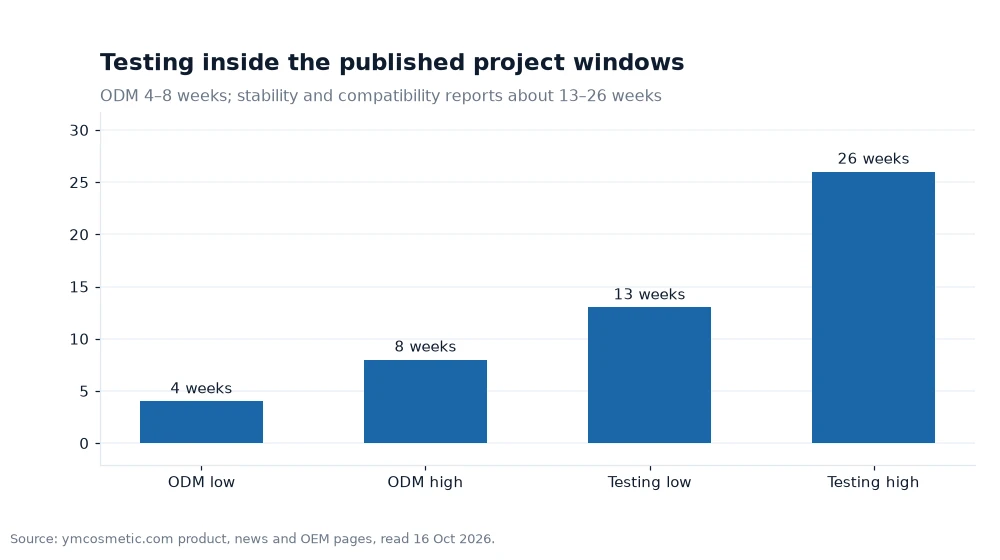
The two numbers that matter most on the chart are 4 weeks and 26 weeks. The 4 is the fastest published ODM lane and sets the earliest point at which a saleable sample can exist. The 26 is the outer edge of the testing window and sets the latest point at which a defensible claim can be signed off. Everything between those two bars is buffer, and buffer is cheaper when it is planned before sampling than when it is discovered after packaging is printed.
What to lock before you request samples
Decide three things first: the claim each product will carry, the texture target for each, and the pack format for each. With those fixed, an ODM brief on an existing formula can move inside the published 4–8 week lane instead of drifting into a full development cycle.
Then decide the outer limit. If a claim rests on a stability or compatibility report, the calendar must respect the published 3–6 month testing figure, and any sensitive-skin wording has to wait for patch test results. Setting that limit early is how a two-product range reaches the shelf on one schedule instead of two.
Frequently asked questions
Can one formula serve both the day and the night product?
It can be filled twice, but the client's page names reusing one formula as the common mistake, because texture, packaging and market expectation each differ between the two products.
How long does testing take?
Stability and compatibility reports take 3–6 months, and any sensitive-skin claim also needs patch test results before it can go on pack.
How fast can an ODM eye cream brief start?
An ODM project runs 4–8 weeks on an existing formula, while a full OEM project runs 3–6 months including research, testing and production.
Start the two briefs together
Bring both products into one kickoff so the lab can hold a single base and split the finish. Yunmei runs OEM/ODM eye cream projects from a shared brief and keeps the published lanes visible, so you can see which decisions belong to the day jar and which belong to the night. The eye cream category page is the fastest place to check what the factory already holds on file before you write the sample request.
The order bands, project windows and factory data come from the manufacturer's website, read 16 Oct 2026.[1]